It isn’t rocket science…or is it?
Dear colleagues,
Summer is finally here. I’m writing this just after the solstice, from a rare and much-needed vacation in Italy with our children. Getting away from the day to day grind has provided some well needed perspective, including on the ASBMT and its mission.
Like many of my generation, I was fascinated as a child by our efforts to reach beyond our own planet for the first time. My earliest memory of a television broadcast is of watching grainy black and white images of the moon walks of Apollo 14 in 1971. Indeed, my first career goal was to be an astronaut. While I never achieved that dream, I was fortunate to begin a collaboration when in Houston with a colleague at Johnson Space Center in NASA. Our role was to help those studying immune responses in astronauts better characterize virus-specific T cell responses.
This led to an interesting collaboration to study shuttle, and later ISS astronauts. Eventually, we proposed to study the effects of human spaceflight on thymopoiesis, which we surmised might be affected by endogenous stress. Not surprisingly, being strapped into a giant rocket and accelerated at 3g induces both physical and emotional stress. While our collaboration suffered serious setbacks (including the tragic loss of the Shuttle Columbia) Cara Benjamin in my group and our NASA collaborators eventually published an interesting paper showing that spaceflight did, indeed, reversibly suppress thymopoiesis.
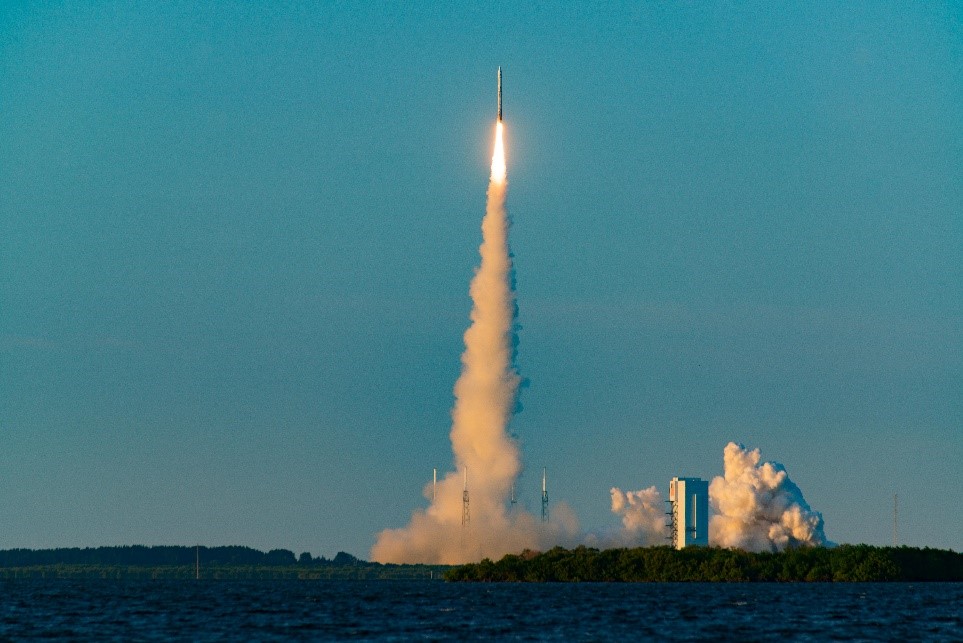 Image by Krishna Komanduri, MD
Our astronaut thymopoiesis paper attracted some press, and one of the upsides of this publicity is that I was accepted, along with other applicants, to attend a “NASA Social,” an event where educators and those active on social media converge on Kennedy Space Center for private tours, interactions with senior NASA administrators and VIP viewing of a rocket launch. In our case, we viewed the Atlas V launch of the OSIRIS-REx spacecraft, which will rendezvous (and ultimately sample) a deep space carbon-rich asteroid that may hold clues to the biological origins of life. During this trip, I developed a clearer view of how NASA is structured and engages the public, and took home some lessons that are worth considering.
We must advocate effectively for research funding. Despite the fact that NASA’s research directly affects fewer individuals than cancer research, NASA has maintained strong advocacy, resulting in funding for its programs that currently amounts to approximately $19.5B, a number that is nearly 2/3 that of the NIH budget and roughly 0.5% of Federal spending. At its peak, in the mid-1960s, the budget was nearly $6B (over $43B in 2014 dollars) and amounted to over 4% of Federal spending. One reason for this success is due to public advocacy by well-known scientists (e.g., physicist Neil deGrasse Tyson, who has advocated for doubling of the NASA budget to “a penny on the dollar”). I would suggest that we borrow this goal, asking that instead of decreasing funding by roughly 20% (as in the FY18 proposed budget) that we collectively lobby for an increase in NIH spending to 1% of the Federal total. This would increase funding by roughly 30%. Like NASA spending, downstream economic yields would include science and technology jobs, economic development and translation from basic science to everyday benefits.
We need to translate the value and benefits of medical science in simple terms. When was the last time you said, it isn’t rocket science? Indeed, why don’t we say “it isn’t transplant science?” The things we routinely do to save lives are no less than remarkable—selectively targeting individual cellular subsets, transplanting entire hematopoietic systems and applying targeted immunotherapies. Indeed, the basic science of rocketry has evolved less since the late 1960s than immunology. While there are less than 1800 Ph.D. physicists who graduate each year (less than 10% of the number of M.D. graduates in the US) how many individuals in the public can name a famous physician beyond the surgeon general? Yet many can name more than one astrophysicist (Tyson, Hawking, Sagan). One reason for this is that NASA directly engages educators, providing direct support for STEM education. This results in broad interest for their mission, and even the rather narrow career choice of astronaut. While some of us struggle to fill fellowship slots in our field, NASA recently received more than 18,300 applications for their latest class of 12 potential astronauts! While many of us have taught at the graduate and undergraduate level, how many have directly participated in middle school or high school STEM education? Such engagement is a central part of NASA’s strategy.
We need to evolve our communications strategies with the times. Like many ASBMT members, I’ve started to use Twitter to engage people about our mission (follow the Society at @ASBMT or the President at @POASBMT). However, I was surprised that NASA actively communicates on 16 different platforms! The OSIRIS-REx spacecraft has not only a mission webpage, but its own Twitter account with nearly 45K followers! I know some of you are skeptical, noting that many of our patients primarily use traditional communication means (TV, print, internet searches). I learned, though, that many of the “younger” (i.e., under 30) crowd invited to the NASA Social never used either Facebook or Twitter, preferring Instagram, Snapchat or tumbler to communicate with their large audiences on platforms with which I was barely familiar. For most people under 30, these platforms are the primary ways of receiving news and information. What NASA realizes is that the generation engaged on these platforms will be their primary source of support and advocacy tomorrow. These individuals will also increasingly become our patients, advocates and benefactors, and we must reach them where they interact.
The lessons discussed above are inter-related. NASA has endured indifference with the end of the Apollo era, concern and tragedy with two tragic shuttle incidents and legitimate debates about the need for seemingly esoteric science when people in this country lack basic needs. Yet NASA continues to excite the public about truly groundbreaking basic science (e.g., How do we manufacture rocket fuel from Martian soil? Grow potatoes on another planet? Analyze amino acids from an orbiting asteroid?) We in medicine should work harder to develop better strategies to translate the exceptional and meaningful things we do to students, the general public and our elected representatives. Let’s find ways to do this creatively across our ASBMT SIGS and committees to ensure growing, not diminishing, support for our own thrilling missions. If we succeed, perhaps someday we will hear the words “it isn’t immunotherapy!”
Until next month, Ciao!
Krishna
Read the entire July 2017 ASBMT eNews here.